



Hi, I’m Nicolas, Head of Research at Vsquared Ventures. For almost ten years, I wrote this newsletter as European Straits, then Drift Signal, mostly about tech, startups, and venture capital. Last week, I renamed it The Arden Letter to reflect a shift in what I think matters most: the capital, industrial capacity, and alliances that determine whether the West can still build and what we can learn from China, which has outmanufactured us.
My starting point is a macroeconomic observation, which I’ll keep coming back to: Europe exports its savings to American financial assets, while America has exported much of its manufacturing to China. The result is a West rich in capital but increasingly short of the capacity to build. I call it “the West’s carry trade against itself,” and this edition is the first installment of a long series about it.
This series is important from both a US and European perspective because the clock is ticking for both sides. Following Trump’s trade war in 2025, Chinese exports are now landing in Europe, the last large manufacturing base in the West, and every factory that closes takes its suppliers and process knowledge with it—causing permanent harm to the West as a whole.
On a topic like this, opinions are cheap. So from now on, I’ll try and back every argument with data, which is why you’ll find charts throughout these editions, built from official sources and cited at the bottom of each one. Please don’t hesitate to send feedback on those.
Thank you for reading and making this work possible. Read along 👇

1️⃣ Europe once had factories and no money. Now it has the money and sends it away.
What was the state of Europe right after the Second World War? You would be forgiven for thinking it was completely ruined. So many bombs were dropped across the continent, and so many battles had been waged to force Nazi Germany back until the fall of Berlin, so everything had to be rebuilt, right? Well, as it turns out, not really.
Sure, bombing had cut rail lines, bridges, and canals to deprive the Germans of coal, steel, and gasoline. In Germany, it had also flattened cities to break civilian morale. Factories had taken hits too, but machinery had survived far better than buildings. Wartime investment had even expanded capacity: West Germany’s industrial capital stock in 1948 was slightly larger than in 1939. In sum, postwar Europe still had plants, workers, and precious process knowledge. What it didn’t have was the dollars for fuel, inputs, and machines.
This is exactly what the Marshall Plan was designed to solve: by providing $13 billion to Europe ($180 billion in today’s dollars—not that much!) and through cooperation between European countries (which gave birth to the EU), America made it possible for Europe to restart its industrial engine within a few years, while expanding the industrial base on which the Atlantic alliance would stand for decades, notably in the context of the Cold War against the Soviet Union.
Fast-forward to 2026: the situation has been reversed. Now it is Europe that holds the dollars. In fact, Europeans hold even more capital than they know what to do with!
Yet while European factories now close one after another due to the China Shock 2.0, a growing share of Europe’s capital is invested in the US, where the hottest trade in town is not investing in factories but essentially deploying in AI and related assets. As a result, a large and growing share of Europe’s capital ends up in US tech and finance rather than domestic industrial capacity. According to the ECB, while euro-area investors doubled their equity holdings over the past decade, they quadrupled their holdings of US stocks, mostly because US stock prices kept rising. Over the same period, German industrial output fell 9%.
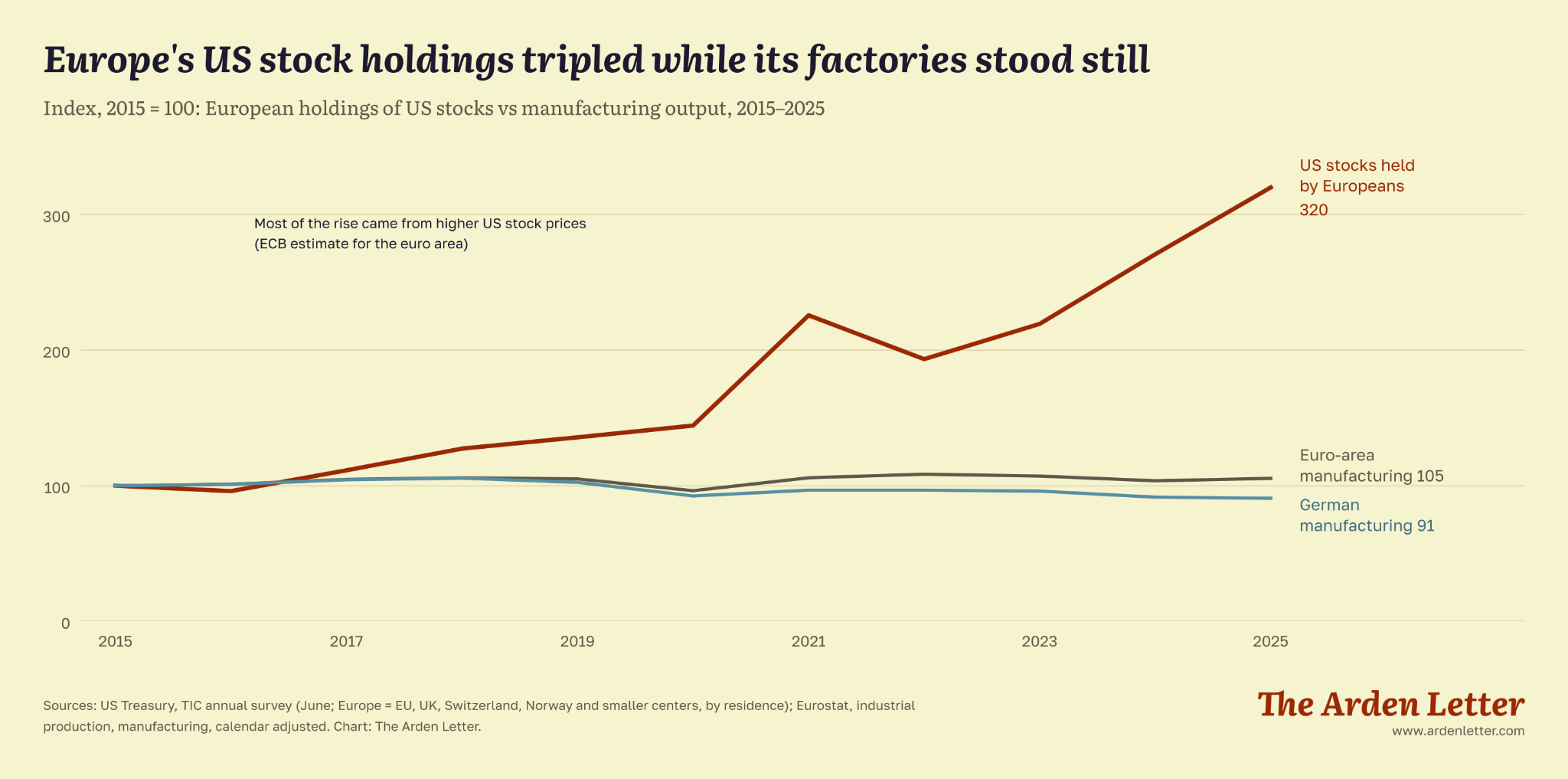
What this means in one sentence: Europe sends its savings to America, the one Western economy that’s already running too hot, while its own factories come under pressure and sit idle.
2️⃣ The West runs a carry trade against itself.
As I wrote in the launch edition, the West has run a transatlantic carry trade against itself for some time, borrowing cheap (in Europe), investing where returns are higher (in the US), and pocketing the spread. Europe provides the funding leg, while America is the asset leg, absorbing European savings and investing them in US stocks, bonds, and alternative assets—including venture capital.
This transatlantic carry trade is sustained by two self-reinforcing loops.
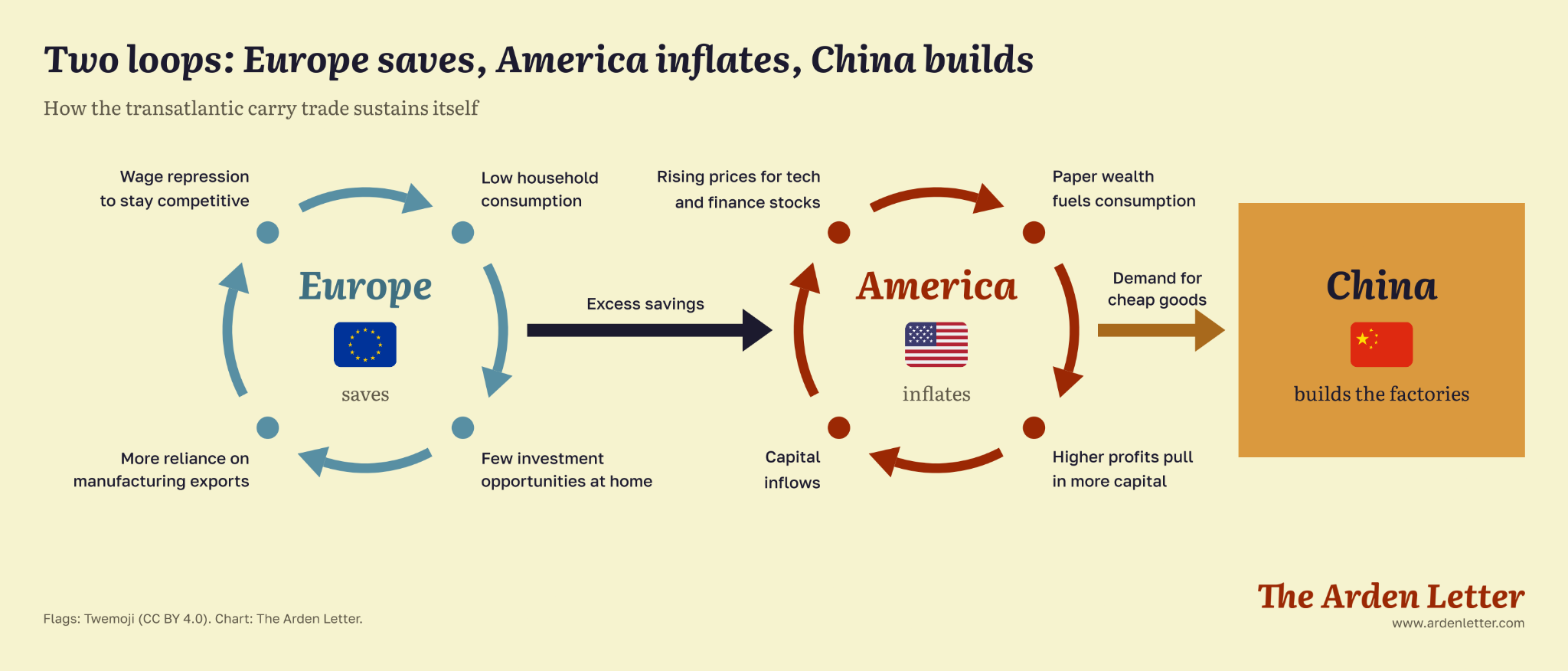
In Europe, excess savings exist in the first place because substantial parts of the continent, starting with Germany, have decided to specialize their economies in manufacturing, which in turn relies on exports. In doing so, they benefit from a euro made relatively weaker by being shared with less competitive economies in the Eurozone (more on that below), but in addition, they still have to maintain competitiveness by repressing wages, which in turn weakens consumption.
Then low consumption, made even worse by weak demographics and fiscal austerity, makes domestic investment opportunities scarcer, pushing even more European capital toward the US. That, in turn, means fewer new businesses and less diversification, leaving Germany’s economy even more reliant on its existing industrial base and its (now-struggling) manufacturing and export sectors.
And so the cycle starts again, with even more wage repression and even more excess savings.
(Friedrich Merz said as much early last year when he argued that, in the face of Chinese competition, German workers would have to work even more for stagnant wages—essentially saying that because the policy hasn’t worked so far, Germany needs to stay the course and push it even further 😩)
Meanwhile, in the US, capital inflows contribute to inflating asset prices, which makes it easier to generate short-term returns across the stock market and alternative assets. US factories generally struggle to compete for capital against tech and finance from a risk-adjusted return perspective, but now they face three additional constraints: (i) rapidly rising asset prices, which increase competition for capital; (ii) labor shortages, as the US economy runs hot and workers are scarce; and (iii) a dollar that stayed strong for most of the past decade, making US factories less competitive globally.
As a result, capital, both foreign and domestic, is definitely abundant in America but, despite Trump’s best efforts, continues to flow into tech and finance rather than factories. At the same time, strong consumption, fuelled by rising asset prices, keeps demand for cheap manufactured goods high, sustaining investment in new factories in China just as the West continues to deindustrialize.
And so the cycle starts again: more capital flows from Europe into US financial assets, manufacturing investment increases in China, and the West becomes less industrial in aggregate.
Taken together, these two loops, one in Europe and the other in the US, explain how the same capital flows can simultaneously deepen Europe’s excess savings, inflate US financial assets, and accelerate the West’s loss of industrial capacity.
3️⃣ The West is running out of time to build.
The end result of this game is a terrible mismatch across the Atlantic. In the US, European savings add to domestic capital in an economy running hot, with low unemployment, rising prices, and an inflation rate that has remained above target for years.
In Europe, meanwhile, there is spare capacity in the form of unemployment and idle factories in the South, and now factories are closing even in industrial powerhouse Germany due to fierce Chinese competition and high energy costs since 2022 (see announcements by VW and Audi). Yet instead of putting that spare capacity to work, European savings flow to America and boost asset prices there.
If anything, Trump’s policy has amplified this dynamic and hastened the West’s industrial decline. China has pushed exports harder since its property bust in 2021. Then diversion toward Europe accelerated with the Biden administration’s 2024 US tariffs on Chinese electric vehicles. As Trump then raised tariff barriers much higher from April 2025 onward, China, which wants to keep exporting, redirected even more of its trade toward more accommodating Europe.
This is the China Shock 2.0 that everyone is covering these days: in the first ten months of 2025, European Union imports of Chinese industrial robots rose 151% by weight, at prices per kilo 37% lower. Chinese carmakers, hit by EU tariffs on electric vehicles, shifted to plug-in hybrids, whose imports nearly quintupled (also by weight).
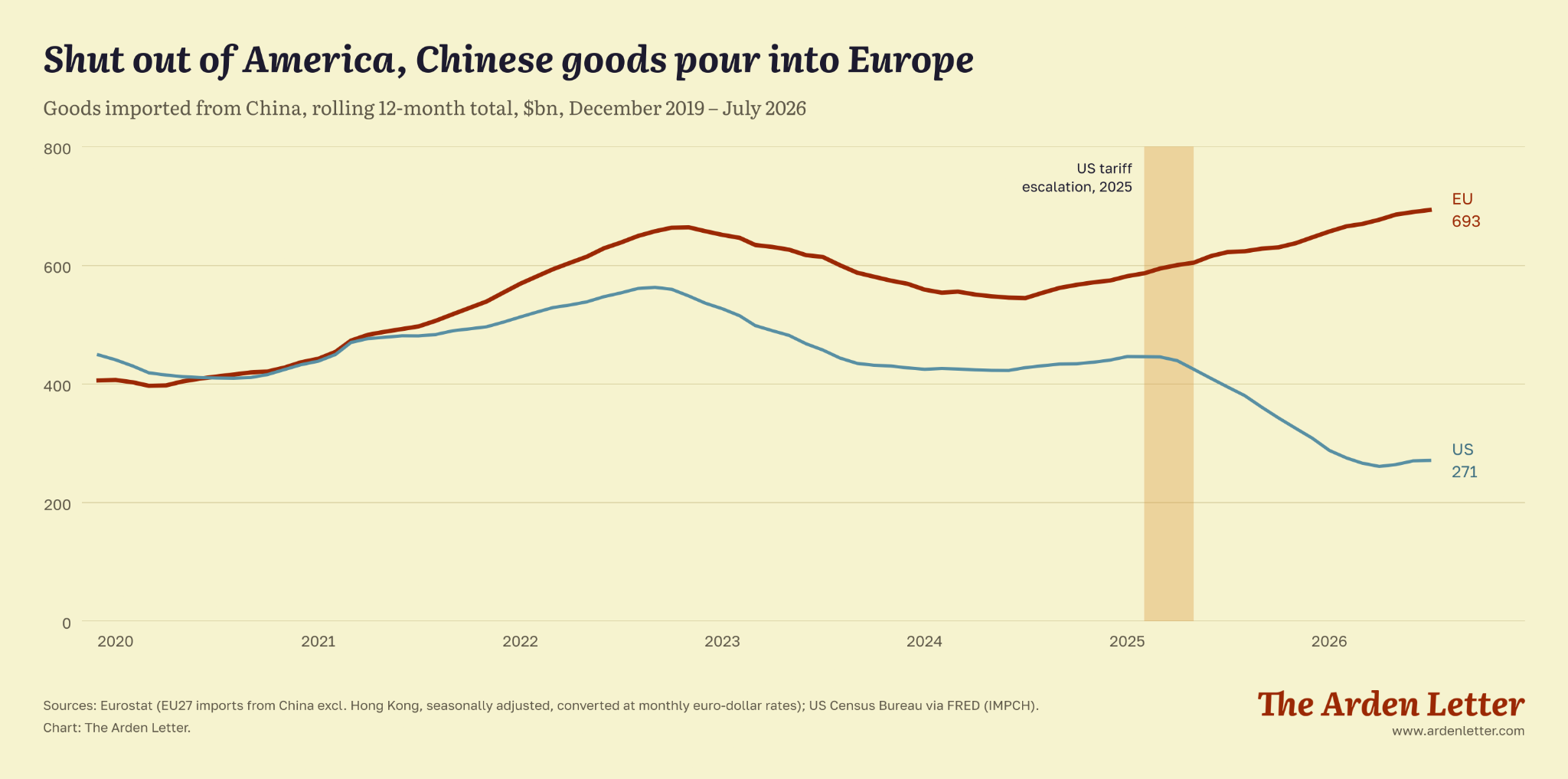
In other words, by trying to protect an America that has already lost much of its industrial base, the Trump administration ended up pushing even more Chinese exports onto Europe, the last large manufacturing base in the West, accelerating Europe’s own deindustrialization. What that means is that the transatlantic carry trade is destroying Western industrial capacity at the aggregate level.
In the next sections, I’ll take up three important, still unanswered questions:
Why does Europe keep exporting savings?
Why can’t America absorb them productively?
And the most pressing one: How long do Europe’s factories have before the last Western industrial domino falls to China?