



Hi, I’m Nicolas, Head of Research at Vsquared Ventures. In this series, I keep coming back to one observation: Europe exports its savings to American financial assets, while America has exported much of its manufacturing to China 😓.
The previous edition looked at this mechanism, which I call “the West’s carry trade against itself.” Today I want to look at the American end of that trade and ask a simple question: why is America constantly running so hot?
Currently, the US economy is breaking every known law of financial physics. Washington is maxing out the national credit card, yet the country’s stock portfolio keeps going parabolic. By all historical precedent, a system like this should be tearing itself apart. Instead, it runs hotter, faster, and larger than ever.
I don’t think the explanation is some cultural edge that makes America better at entrepreneurship and finance or lighter regulation. To me, what explains America’s red-hot economy is three coupled reinforcing loops. Credit and trade pour dollars into the third, the overflow, which turns them into heat, and that heat feeds back into both.
Fair warning: this edition is a bit wonkish, with plenty of balance sheets and financial plumbing. But I believe it’s a necessary step if we want to figure out how “Allied scale” should work across the Atlantic. Read along 👇

1️⃣ America borrows as if in a recession, yet its economy is booming.
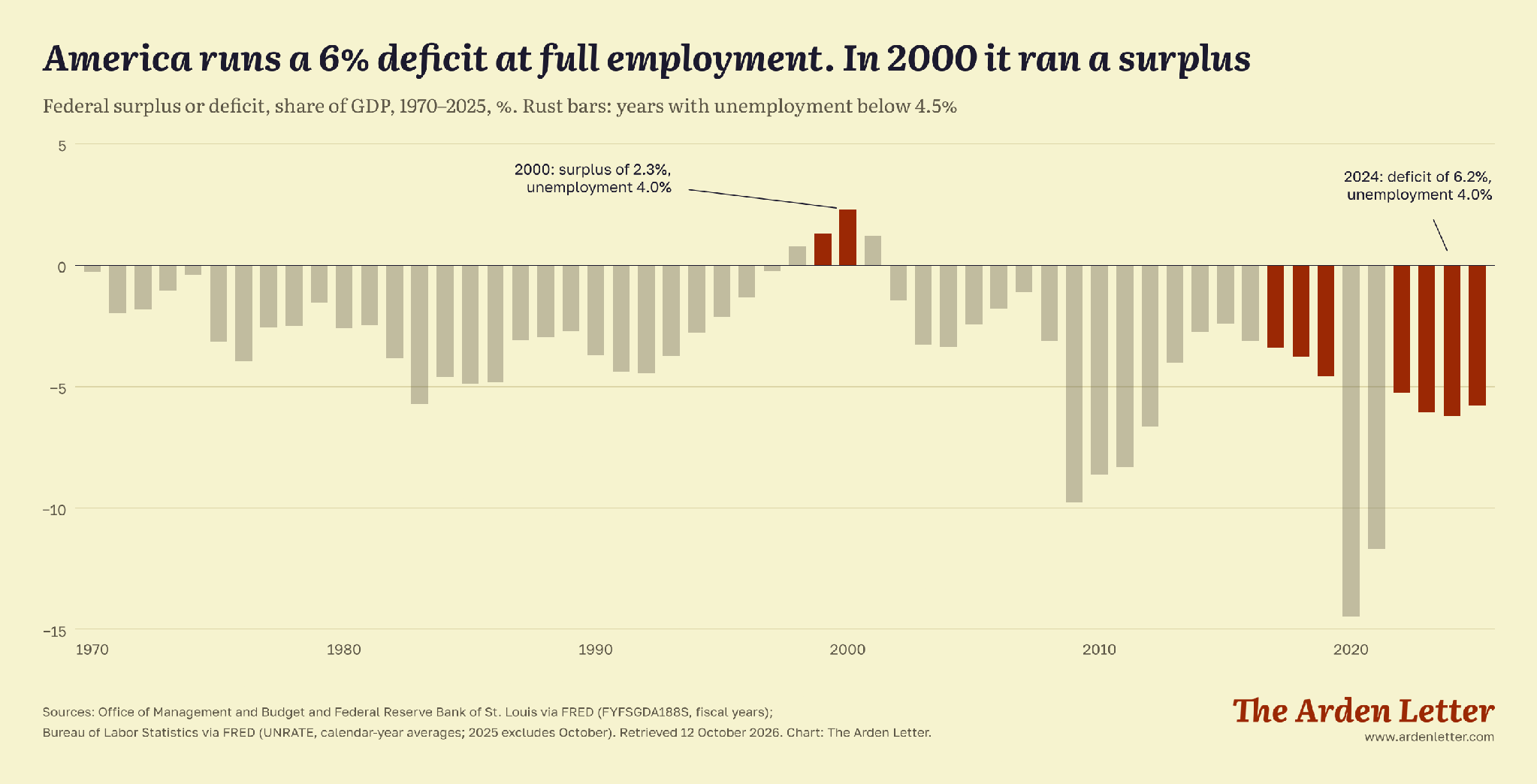
From a macroeconomic perspective, the US economy looks unusual these days. The federal government is running a budget deficit of about 6% of GDP even though the economy is at full employment. Washington is borrowing heavily at a time when most people who want a job already have one.
By contrast, at the end of the Clinton administration in 2000, US unemployment was just as low, but the federal government was running a budget surplus and paying down the national debt.
At the same time, America runs a current account deficit of about $1.2 trillion a year: it buys far more from the rest of the world than it sells and covers the gap by selling American assets to foreigners.
Textbook economics says these twin deficits (the fiscal deficit and the current account deficit) should end badly. If the US were an emerging market, you’d expect a currency crisis, capital flight, and the IMF knocking on the door. Deficits at full employment should also fuel inflation and crowd out private borrowers, as the government competes with businesses for funds.
Look out the window, though. Far from being squeezed, the private sector is awash with cash: stocks keep hitting records, private credit is expanding at a scale we’ve never seen, and AI investment is booming. It’s like watching a car with a fuel leak and smoke coming from the engine speed up on the highway!
So the real question is, where does the money come from?
2️⃣ America works like an asset manager for the world’s savings.
To understand the math, stop looking at America as a country that makes things and balances a budget. Look at it as a financial institution instead: the world’s largest alternative asset manager, which I previously called “America Capital Partners,” or ACP.
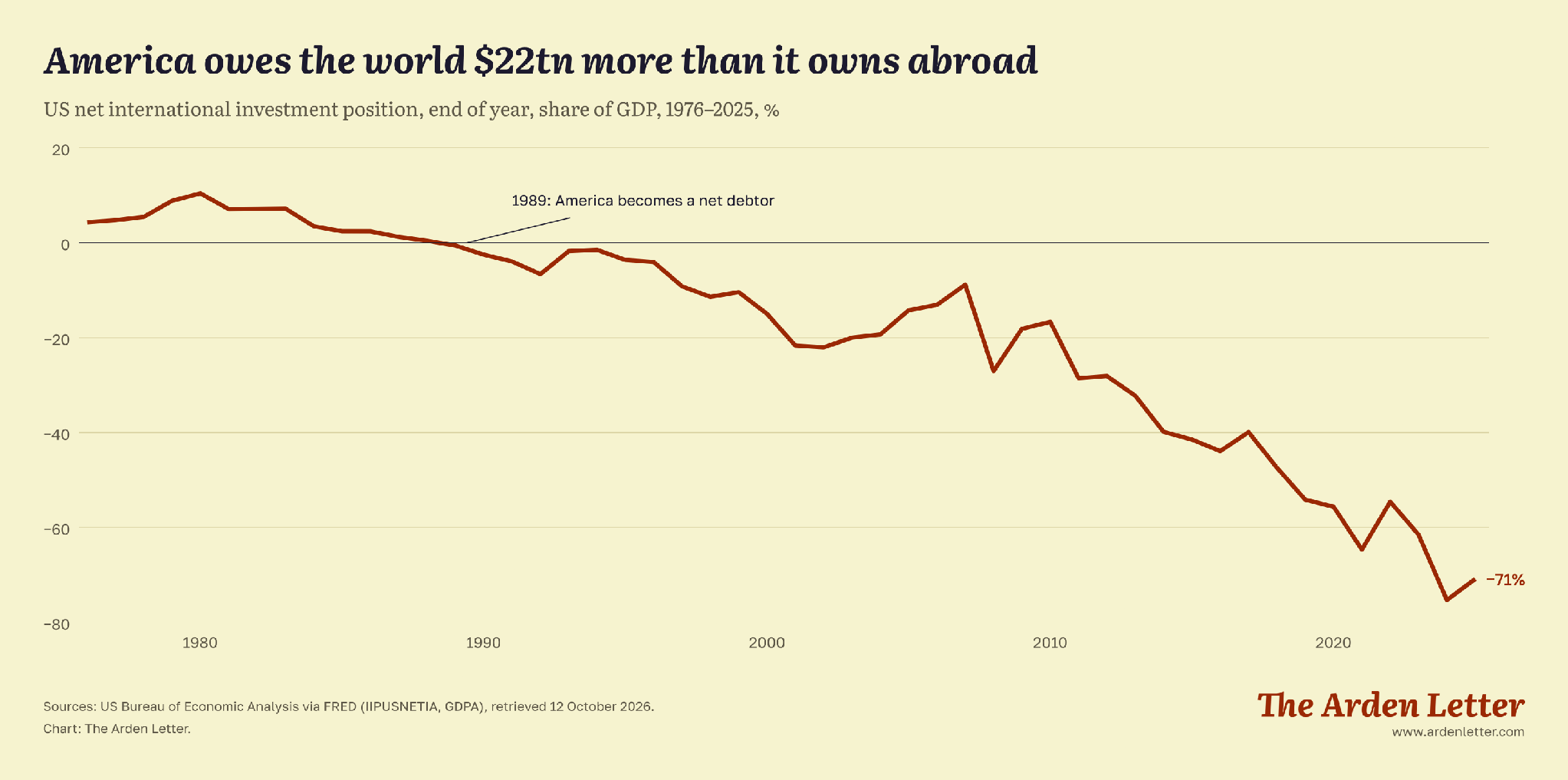
ACP’s key metric is its balance sheet. The US owes the rest of the world $22 trillion more than it owns abroad, about 71% of GDP. While America imports (lots of) goods, it effectively exports financial assets, and the world is paying it to manage its wealth.
Like any asset manager, ACP earns two kinds of income:
A management fee. Mild dollar depreciation and inflation slowly erode the real value of what foreigners park in US debt.
A carried interest. ACP’s limited partners, the foreign savers, mostly hold safe, low-yielding Treasuries, while domestic investors own the riskier assets that pay off: real estate, tech stocks, private equity, and venture capital.
Interestingly, America wasn’t always an asset manager. In 1966, economists Charles Kindleberger, Emile Despres, and Walter Salant argued in The Economist that America was in fact the world’s bank: it borrowed short from the world, through deposits and Treasury bills, and lent long abroad, through American companies building factories in Europe. But three things then turned that bank into a private equity firm: the end of gold convertibility in 1971, permanent trade deficits from 1976, and from the late 1990s what I call the overflow mechanism (more on that below).
The current system makes the US economy dependent on a steady flow of foreign money through three connected loops. In credit, the world borrows dollars. In trade, the world earns dollars. Both dollar pools then pour into the overflow mechanism, which then turns them into heat. The heat then feeds back on both credit and trade.
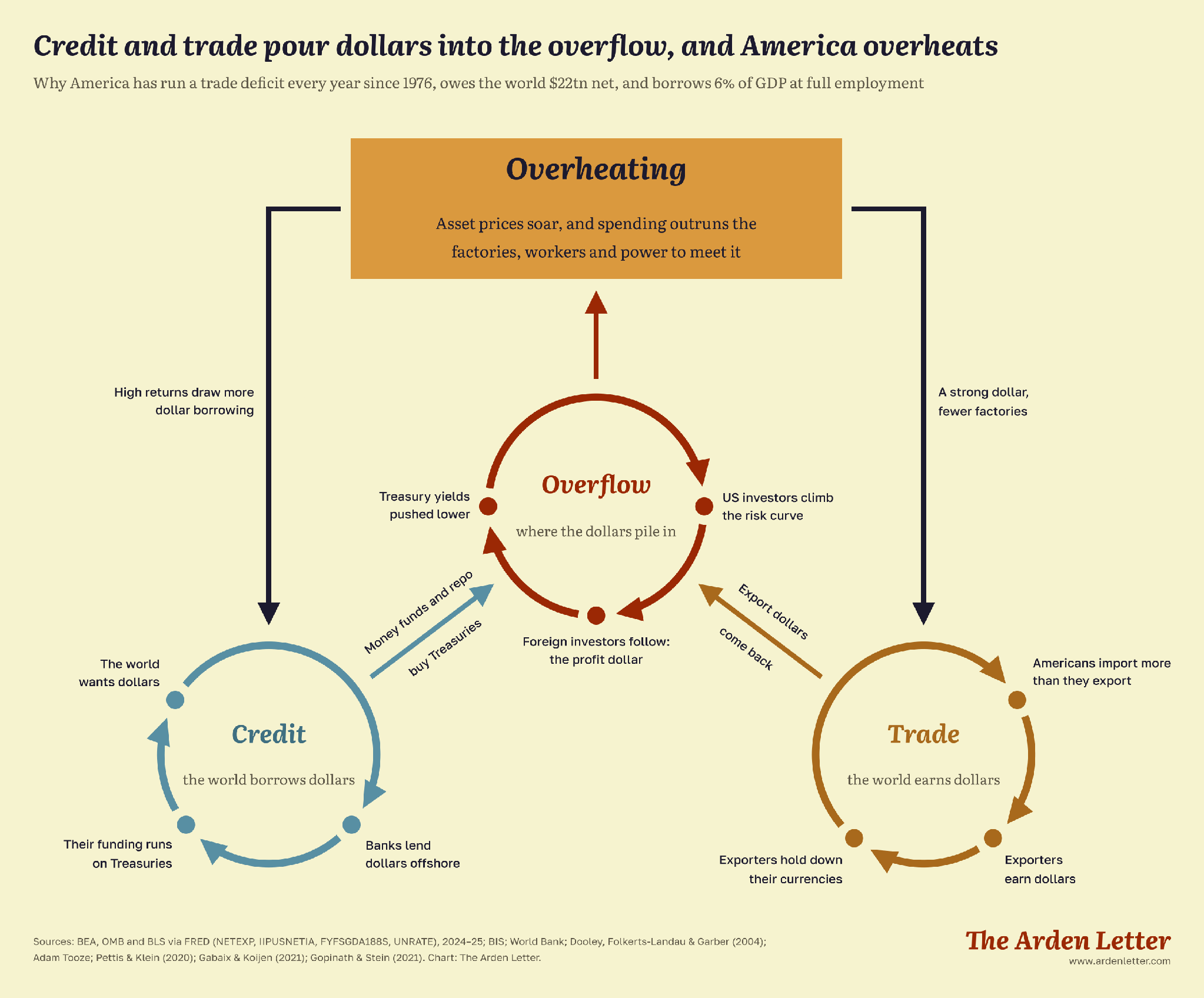
That’s the system described in one chart. The rest of this edition walks through each loop and leads to the question at the heart of this newsletter: since Europe’s savings power America’s overheating, shouldn’t the two sides of the Atlantic share the money and the building instead?
Along the way:
Who actually creates the dollars the world borrows, and why does the Fed end up backstopping all of them?
Why do the dollars America spends on imports come straight back?
Why does all this money inflate asset prices rather than build factories?
And how does the cycle end: with a slow cooldown, or with a crash that sends trillions of dollars fleeing America overnight?