



Hi, I’m Nicolas, Head of Research at Vsquared Ventures. My series on how the West got out of balance will resume next week. But this week, I wanted to once again come back to the news, because of what just happened at Nvidia.
I believe Jensen Huang’s resignation will be a massively impactful event. Specifically, in just a few days, the situation has made many things clearer about where AI is at the moment and where it’s going. It shows how Washington now sees AI chips. It also raises a question that matters for Europe: who pays for the AI boom, and will investors ever get their money back?
Indeed, for now, AI is mostly spending, with revenue lying far behind. And while we wait for a return, someone has to bridge the gap by funding the capex boom. And as it happens, a large part of the money comes from European savers, who contribute to building data centers in America—all while Europe’s own grids and power plants wait.
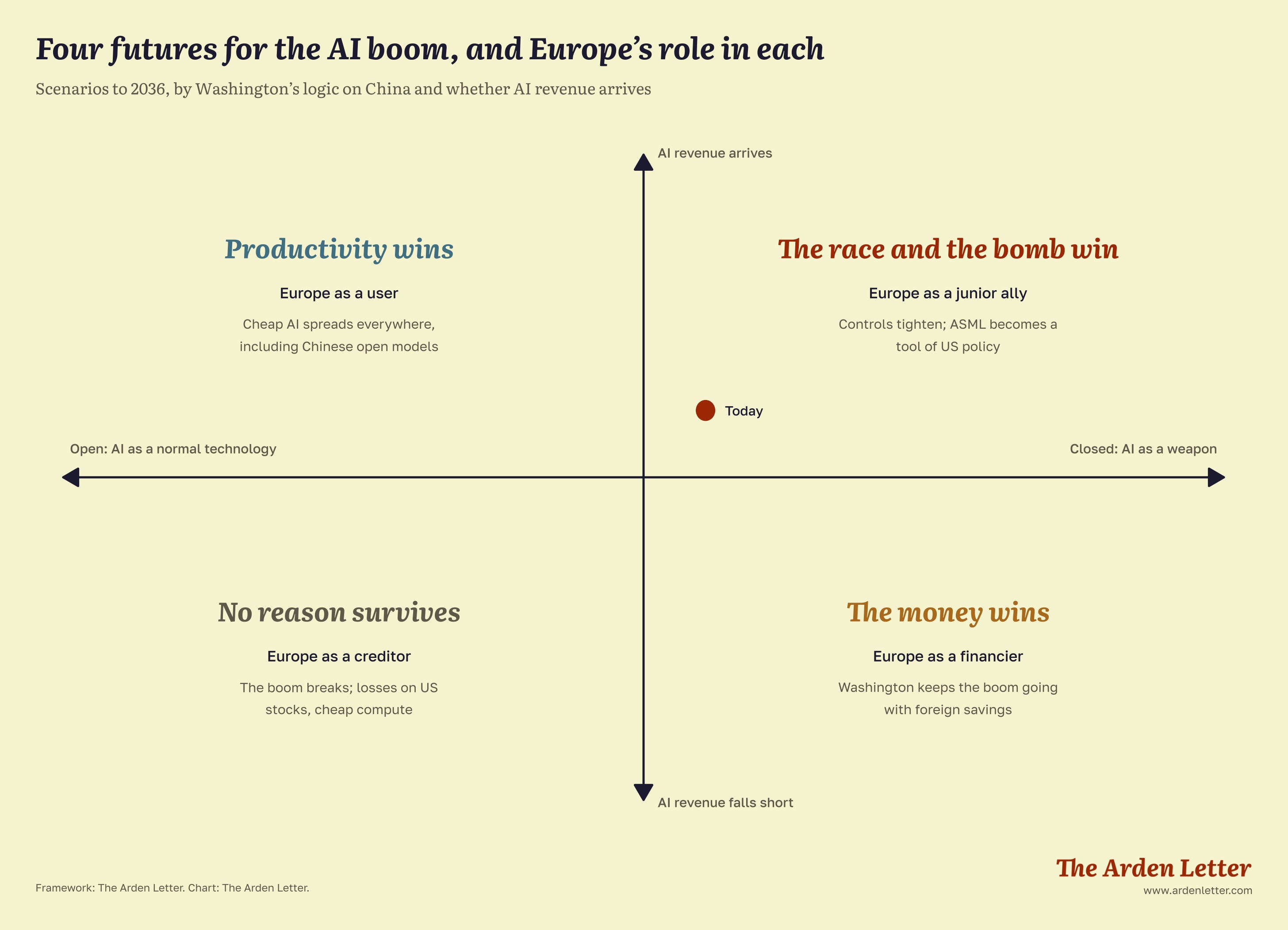
So this week’s edition is about what the Nvidia situation tells us about the next decade of AI and where it leaves the West in general and Europe in particular. Much depends on two questions that are still open. First, will Washington treat AI as a weapon, or let it spread freely across the world? Second, will the investors who fund the AI boom actually make money on the capital they invested? Each combination of answers leads to a very different decade for America and for Europe. Read along 👇

1️⃣ Nvidia’s board pushed Jensen Huang out in the context of a China chip scandal.
On 12 November 2026, Jensen Huang resigned as CEO of Nvidia. He had run the company since he co-founded it in 1993. While the trigger seems to have been a relationship with a direct report, the ground had been prepared by previous revelations about Alice Huang, a former executive of Megaspeed—that is, a Singapore company that until recently was buying a lot of Nvidia chips.
The Justice Department and the Commerce Department are now investigating Megaspeed over potentially diverting Nvidia chips to China, in violation of US export controls. As I’m sure you’re aware, there have been lots of mentions of Alice Huang being a “Chinese spy.” But as Desmond Shum, the author of Red Roulette, recently wrote on his Substack, she was most probably a commercial fixer, whose job was to help Chinese clients access Nvidia chips.
In any case, in the week after Jensen’s resignation, Nvidia lost about $550bn in market value.
Now let me be clear: I only know what I read in the papers, and I can only trust that those journalists are doing their job. But suppose even part of what has already been reported is true. In today’s national-security and political climate, anyone at Nvidia, including Jensen Huang, who did things in relation the Trump administration that were wrong, or close to illegal, is probably very afraid right now and is lawyering up.
There are many public signs that the pressure is mounting on the company:
Treasury Secretary Scott Bessent has publicly asked whether Nvidia pushed these sales to boost its revenue, while pointing the finger at the Department of Commerce.
Three House committees will question Huang and Nvidia’s General Counsel Tim Teter in closed sessions in December.
Under that kind of pressure, I think it’s obvious the board couldn’t do anything except ask Jensen to resign.
Now there’s another question: why now? Much of this information had been public for months. Bloomberg reported on the Megaspeed probe in December 2025. A short seller flagged Alice Huang in May 2026. According to the New York Times, Trump was briefed a year ago.
If anyone covets what made Nvidia so successful, whether its technology, its supply chain, or its talent, the new context makes now the moment to act.
About that, I have two theories about how scandals like this work:
Every leak has an ulterior motive. That is why the best investigative journalists work only from open sources. They don’t want to be used by whoever chose to leak.
The market for scandals is a pull market. Information can sit in the open for a long time until someone has an interest in using it.
This is what happened with the Watergate scandal. It was famously reported before the 1972 presidential election. Nixon, who was running again, still won 49 states and crushed his opponent George McGovern because at the time nobody cared. It only became a scandal later, leading to Nixon’s resignation in 1974. Author Max Holland argues that Deep Throat, the FBI’s Mark Felt, leaked because he had been passed over for FBI director, that is, he had an interest in using information that was already in the open and to reanimate the scandal.
2️⃣ Washington will now treat AI as a matter of national security.
To me, this looks like a modern Iran-Contra. In the 1980s, officials in the Reagan administration secretly sold arms to Iran and used the money to fund rebels in Nicaragua. The scandal led to years of hearings and investigations. Fourteen people faced charges, and many careers came to an end.
The two cases, while differing in many ways, nevertheless unfold in a similar manner. A scandal of this kind becomes dangerous when three forces meet: (i) media revelations; (ii) political posturing at home; and (iii) appeals to national security. All three are now at work.
I already covered the revelations in section 1. Now it’s evident that political posturing is turning these facts into a scandal. Had Trump retained a friendly Congress, and without the current US political backlash against Silicon Valley, any wrongdoing at Nvidia could have been handled quietly. You’d give Jensen and his team a slap on the wrist and clarify the export rules.
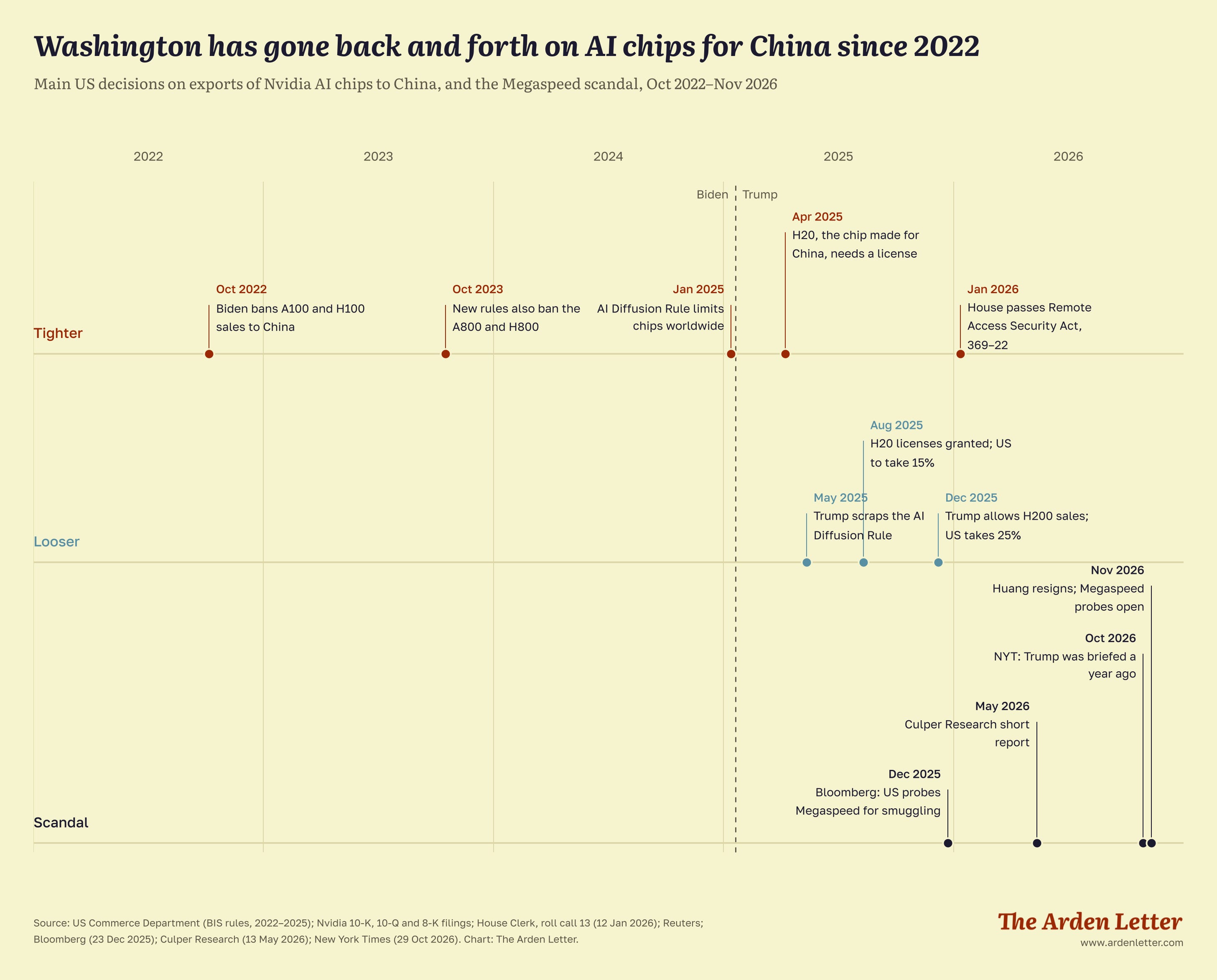
But today, the country is polarized, and many people involved want to look tough on China:
Commerce and the Justice Department have issued a joint statement on their Megaspeed investigation. I suspect they also want to cover themselves.
In Congress, Senator Ron Wyden and Representative Richard Neal have opened an inquiry. They allege that an export approval came after Nvidia and Huang directed at least $26m toward Donald Trump’s personal priorities, including the White House ballroom.
California’s attorney general has already subpoenaed Nvidia. Other state attorneys general could also take independent action.
It’s expected that the Democrats will strike hardest. As geopolitical analyst Marko Papic explained in the latest episode of the Geopolitical Cousins podcast, they have been the China hawk party for decades, from the Vietnam War to Biden’s chip export controls. And they take control of both chambers of Congress in January. May I add that in the US system, Senate committee chairs are very powerful? They decide which topics get hearings. They can demand documents and force executives to testify under oath. Several of them will want to look at Nvidia—notably those in charge of commerce and technology, banking and finance, national security, and foreign policy.
I must say that Silicon Valley has made their job easier. For two years, much of the industry stood with Trump and attacked the Democrats on crypto and AI. Right after Jensen’s resignation, many tech investors and founders rallied around him, clearly without knowing exactly why the board made its decision. Seen from Washington (and from abroad,) this all looks like an industry that protects its own.
And then, national security is the third force. Since Democrats and Republicans agree on almost nothing, China is one of the few topics where they can still find common ground. So the easiest way for a divided Congress to show that it can act is to tighten export controls and treat AI as a weapon. Ben Thompson described in Stratechery what Bessent now expects from a chip company:
Bessent views the matter entirely differently: he thinks that Nvidia should operate like a bank. It’s not just their job to abide by the letter of the law, but the spirit of it. It’s not the government’s job to enforce the chip ban, but the company’s. An attestation from a Singaporean customer that chips aren’t going to China isn’t worth anything; actually putting boots on the ground and ensuring compliance is the only way Nvidia cannot be in violation of the U.S. government’s dictates.
For the tech industry, this is new territory. Since Intel, tech companies have sold to the whole world. Governments could buy their products, but not define them.
Ben’s conclusion is that “the doomers and the hawks have won.” In policy, AI “will be treated as anything but normal.” This has two consequences:
The technology will be harder to get, for China first, then for everyone who must prove where every chip goes.
The US is choosing bans and forced compliance over innovation and openness. In Ben’s words, “I lament the implications of what it says about our belief in ourselves and our ability to stay ahead.”
This is why the Nvidia situation matters beyond Nvidia. It forces a question that America has avoided so far: what is the AI boom for?
3️⃣ America wants three things from AI that it cannot have at once.
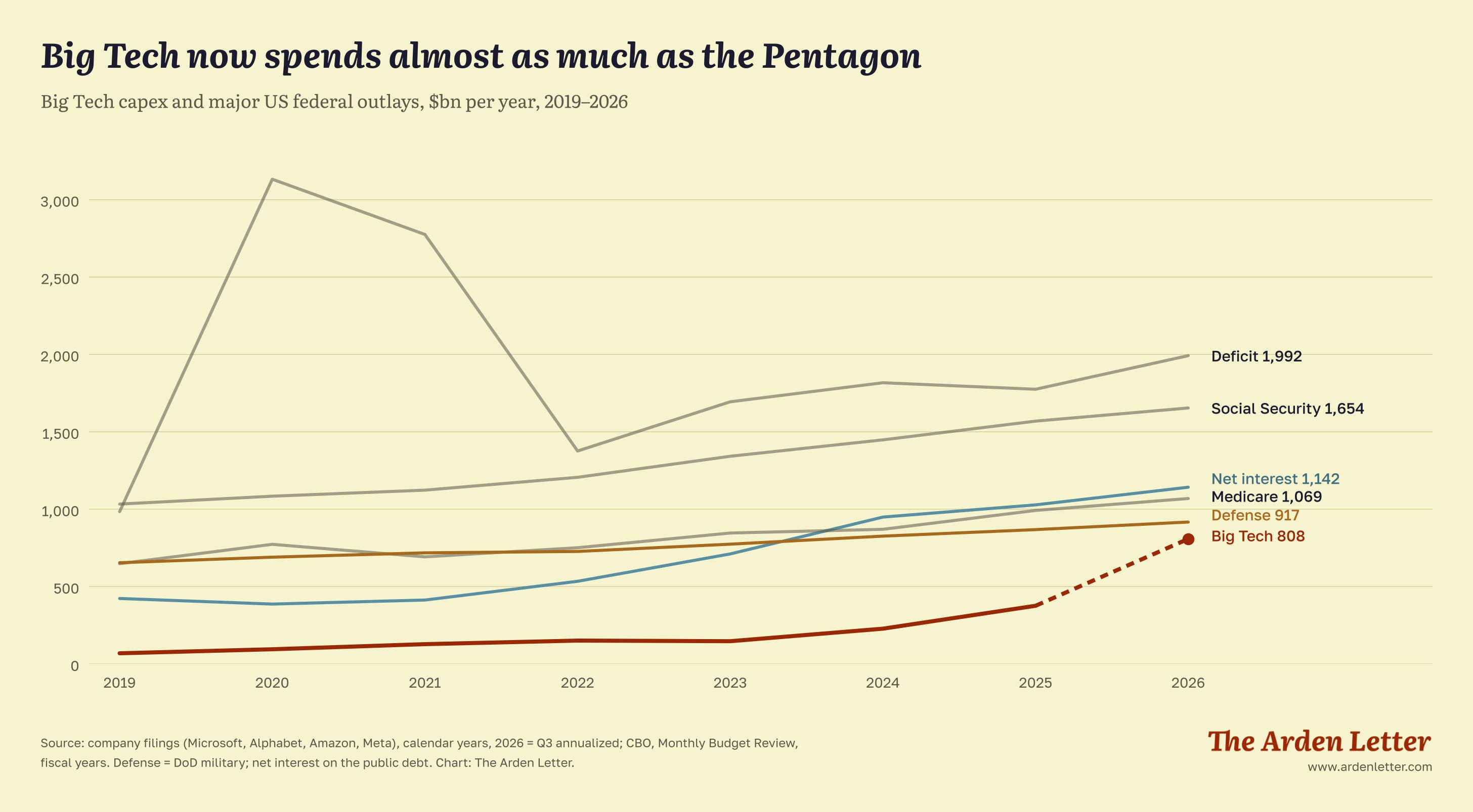
Let’s take a step back. The amounts invested in AI are enormous. In the third quarter of 2026 alone, Microsoft, Alphabet, Amazon, and Meta spent $202bn on investment, mostly data centers, servers, and chips. In early 2019, they spent $14bn per quarter. That is 14 times more in less than eight years.
US business investment in computers, servers, and software is now 5.3% of GDP. At the peak of the dot-com bubble, it was 4.5%. Over the last four quarters, tech investment accounted for about 45% of US growth.
This money has to come from somewhere. AI now competes for capital with governments, which borrow more than ever, and with every other sector of the economy. And it does so while interest rates are rising! At the current pace, the four hyperscalers mentioned above are on course to spend about $800bn a year. The Pentagon spends $917bn. Washington now pays $1,142bn a year in interest on its debt, and it borrowed $1,992bn in fiscal 2026.
Why have we allocated so much money to AI? I’d say it’s because of the hype, the pressure from markets, and the political push from Washington. We are told at every turn that we MUST do this. Three reasons keep coming back:
Productivity. AI should spread to every hospital, school and law firm. For that, it must become cheap and widely available.
Returns for investors. The dominant AI companies must earn a decent return on the capital invested in them. For that, they need high prices and high margins.
Beating China—which itself can be done in two ways. America can flood China with American technology so that China stays dependent on it—that’s the Jensen-David Sacks-Ben Thompson position, which I find quite compelling, to be honest. Or, as now seems more likely, America can prevent China from getting American technology at all—which is the China hawks’s position.
The problem is that you can’t have all three at once—productivity, ROIC, and beating China. Cheap AI everywhere means lower margins, so investors earn less. Keeping China out means a smaller market, as well as compliance costs for every chip sold. Flooding China helps productivity and sales, but the hawks in Washington now see it as treason. Which is why the general outcome now depends on two variables:
Will Washington treat AI as a weapon, or let it spread freely across the world?
Will the investors who fund the AI boom make money on the capital they put in?
By return, I mean the money investors actually make on the capital they contributed. I have to clarify this point because many people now describe AI as a “productive bubble.” To them, even if it bursts (meaning investors lose their shirt), the infrastructure remains, and a few years later society reaps the benefits. This is NOT what I mean by making a return. And by the way, making a return matters a great deal for Europe, because European savers provide a large part of the capital invested in AI.
In the end, the answers provide four scenarios. I look at them from the perspective of the West as a whole and Europe in particular.
In the next seven sections, I cover:
why Europe has a stake in how all this turns out (section 4);
each of the four scenarios and what each means for Europe (sections 5 to 8);
how the two variables feed each other (section 9);
the signals to watch, and what Europe should do now, whatever happens (section 10).