


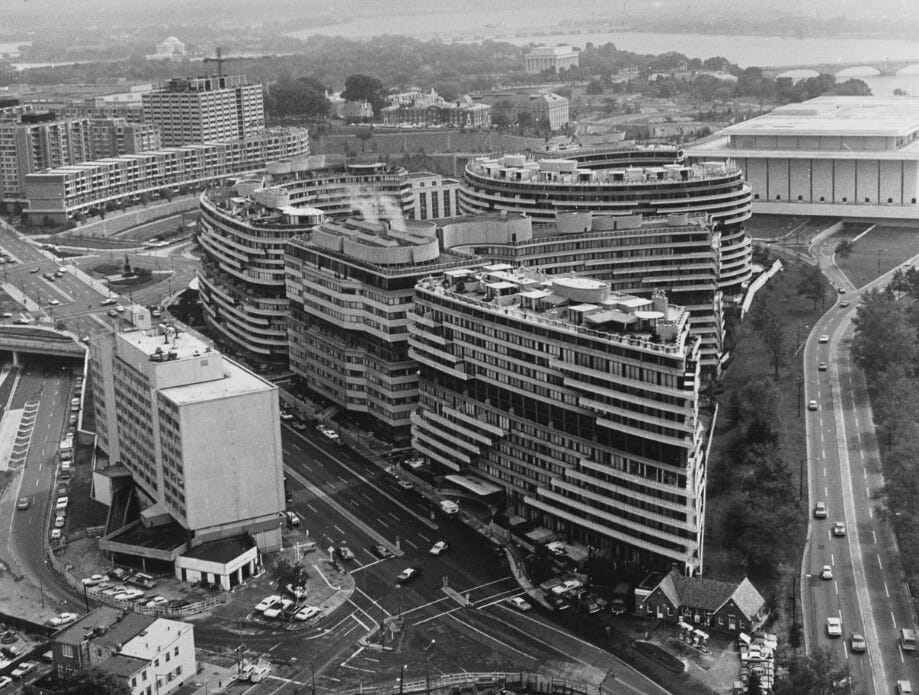
Hi, I’m Nicolas, Head of Research at Vsquared Ventures. For the past few weeks, I’ve been working through a series on how the West got out of balance:
The next edition in that series, on who holds Europe’s savings and where they go, can wait a week. The reason is what happened in America a few days ago.
American politics was once one of my strong suits. I majored in American studies at Sciences Po, graduating in 2002. Back then, I followed everything that happened in America, especially politics. I knew the electoral map like nobody else, and even knew the names of all 100 sitting US senators by heart! Then I turned my attention to tech, business, and finance, where I’ve been active for the past 15 years.
As a rule, I don’t do politics in this newsletter. This time, however, the midterms offer a window into a much bigger economic and technological shift. In one sentence, as my followers will know, I think that we are now in the maturity phase of the age of semiconductors, computing, and networks. The technological revolution that began in 1971 with the invention of the microprocessor is reaching a plateau.
The last maturity phase, that of the age of oil, automobiles, and mass production, took place in the 1970s. We remember that decade for its crisis, pain, and polarization—that’s what maturity brings. But by looking back at it, we can also anticipate much of what comes next. I laid out this view last year in Welcome to the 1970s of Tech.
Indeed, the 1970s offer a useful guide to what happens next: which assets become stranded, what kind of political leaders emerge, and how the West might rebuild itself. So this week’s edition is about why we’re living through 1974 again, and what it means for tech and business, for the West, and for the transatlantic relationship. I hope it will be a convincing invitation to revisit your history books. Read along 👇

1️⃣ Back in the 1970s
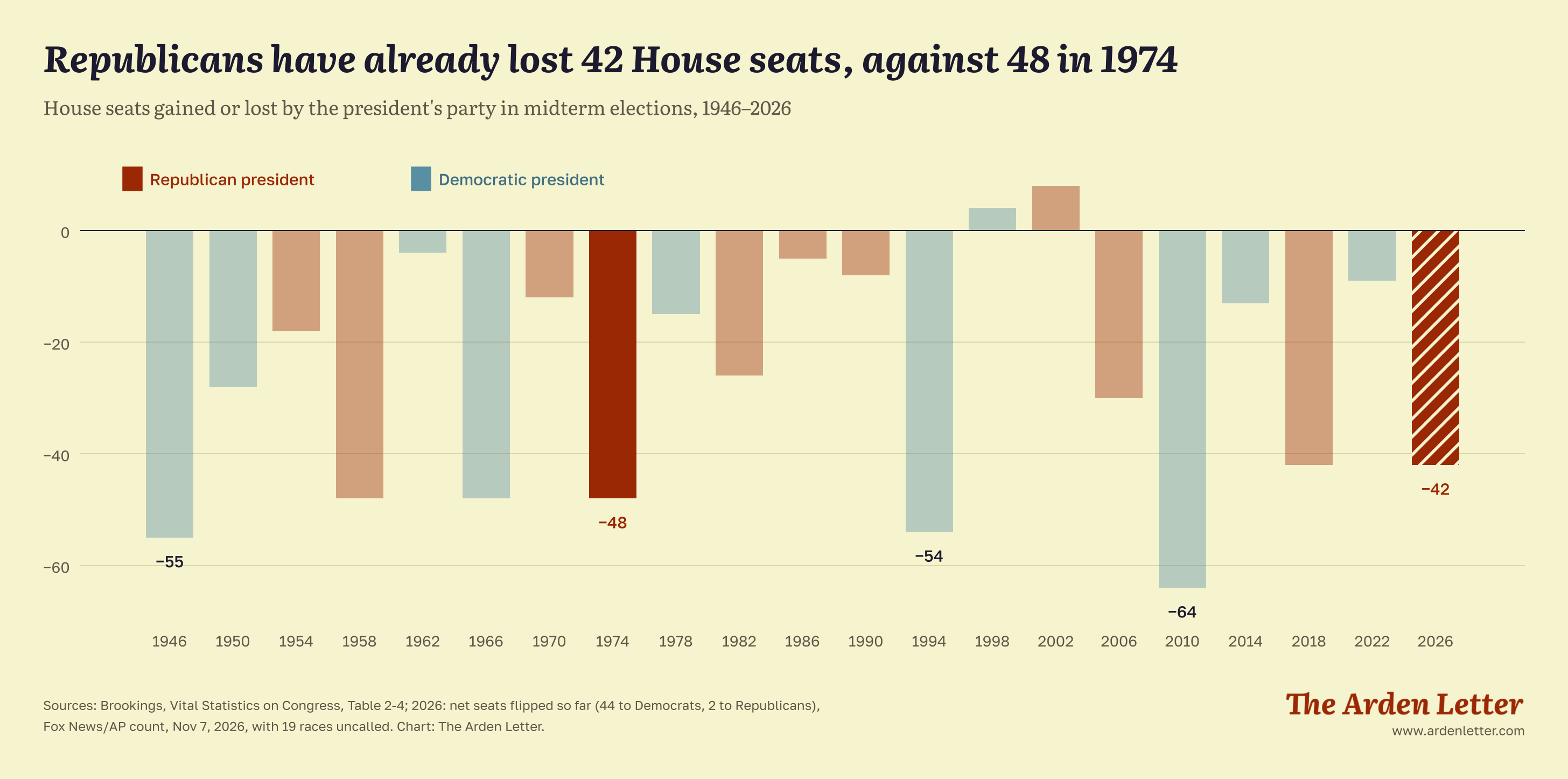
On November 3, Democrats took back both houses of Congress. As of this morning (November 8), the Associated Press counted 254 House seats for Democrats and 162 for Republicans, with 19 races still uncalled. Democrats have flipped 44 Republican-held seats, a net gain of 42 so far, which is already close to the 48 House seats Republicans lost in 1974. In the Senate, Democrats now hold 54 seats to 44, with Mississippi and Alaska still uncalled, and red states such as Texas and Kansas elected their first Democratic senators in decades.
Why does it resemble 1974? In November 1974, America was three months past Richard Nixon’s resignation following the Watergate scandal. Gerald Ford, who had succeeded Nixon as president, had agreed to pardon his former boss, which triggered a national controversy, contributed to further discredit of the Republican Party, and led to trust in institutions collapsing. Even with Nixon gone, voters ultimately decided to punish his party and sent a new class of young reform Democrats to Washington. The press called them the “Watergate Babies”; many of them went on to play a major role in US politics over the following decades.
Donald Trump plays a part similar to Nixon’s today. Sure, he’s still in office, despite numerous scandals arguably far worse than Watergate. But his administration is weighed down by corruption, by an unpopular war with Iran, and by an energy shock that voters feel every time they fill up at the gas station. His approval, which stood in the mid-30s on the eve of the vote, played a key role in Tuesday’s Republican smashing.
My view is that waves like these follow a pattern, as I already argued in The Epstein Files Tell the Institutional Story of Our Time. When a technological age reaches maturity, the economy stops delivering broad gains. Global institutions built for the previous era stop working. Politicians keep pulling levers that worked twenty years ago, and nothing happens. So voters find every reason to throw out incumbents again and again, looking for someone who can finally fix the engine. This is why Trump and the Republicans badly lost the midterms this week.
2️⃣ Americans feel poor in a rich country
Voters are angry for a reason. On paper, as I wrote three weeks ago, America runs hot. It runs a budget deficit of about 6% of GDP at full employment, stock prices keep climbing, and most headline numbers look great. At the kitchen table, however, households feel squeezed. Five forces explain what’s happening at the moment:
A K-shaped economy. Those who own stocks and real estate see their wealth grow, while those who live on wages only see their purchasing power shrink. The result is an increasingly stark divide between asset owners and workers, even as headline economic indicators suggest continued growth.
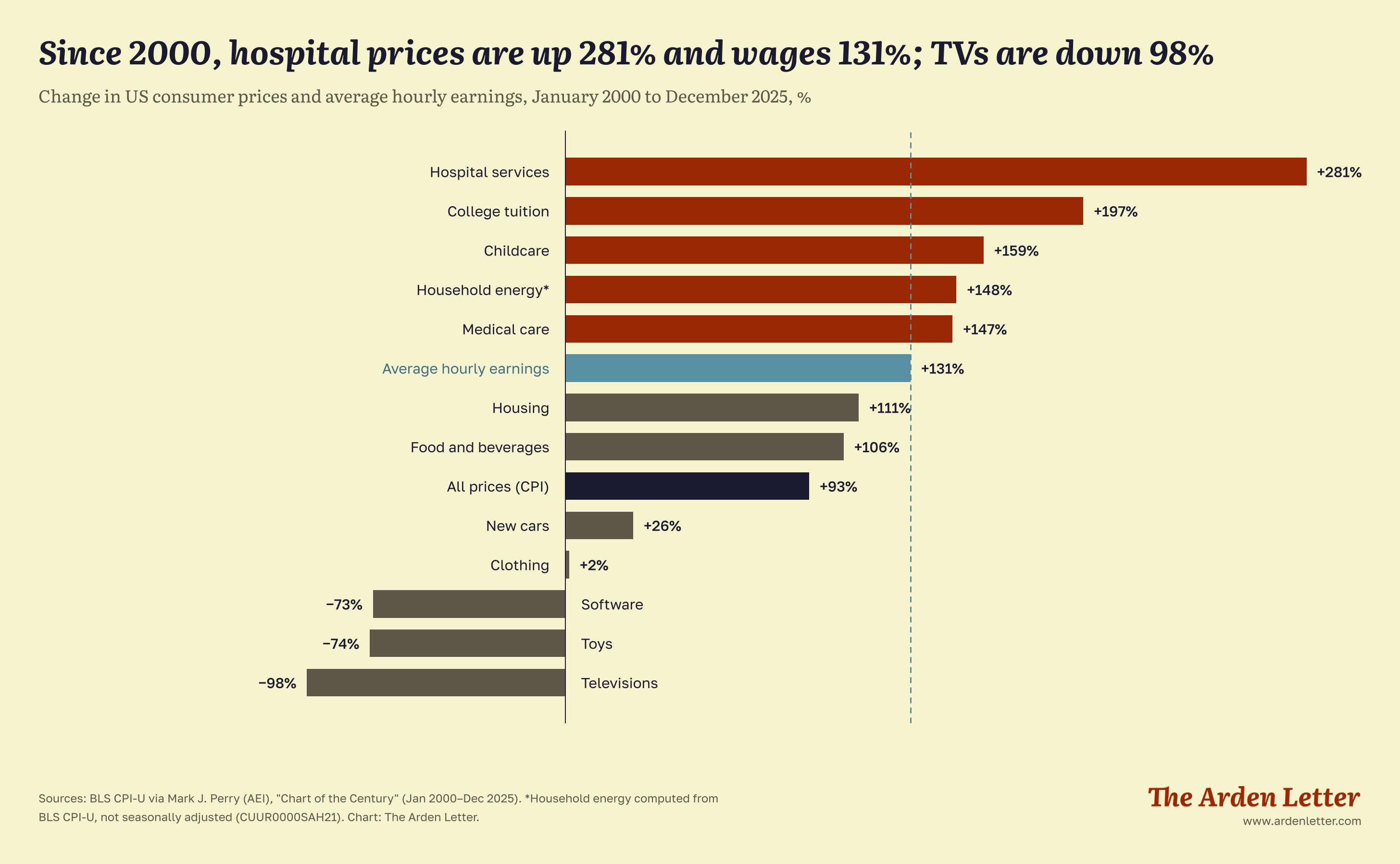
Technology makes goods cheaper, but proximity services more expensive. Between 2000 and 2025, television prices fell 98%, while hospital services rose 281%, college tuition 197%, and childcare 159%. This is explained by both Baumol’s cost disease and market concentration and predatory behavior in sectors such as healthcare.
America is a lawyerly society, to borrow Dan Wang’s concept. Zoning, permitting, lawsuits, and various forms of activism block new housing and power lines. More than 2,000 gigawatts of power projects are waiting to connect to the grid, illustrating the scale of a problem that exists across the entire economy.
Tariffs add another layer of costs. They tax imported goods, including products and components that America no longer makes competitively… or no longer makes at all. Rather than bringing production back overnight, they raise costs for businesses and consumers throughout the economy.
The Iran war adds an external energy shock. Rising oil prices push up the cost of gasoline, diesel, transport, and agricultural inputs. The effects ripple through supply chains, raising the cost of everyday goods and putting further pressure on household budgets.
The situation was similar in 1974, albeit for slightly different reasons. Prices were rising fast, with year-on-year inflation crossing 10% for the first time in the postwar period. A key difference was that unions were much stronger, and many contracts included cost-of-living adjustments, so pay partly kept up with inflation in the short term, even if this also contributed to a wage-price spiral over time. Today, by contrast, US working families get the worst of both worlds: inflation without the raises. The price increases are visible, and the pain is immediate.
3️⃣ Energy shocks feed on a maturing techno-economic paradigm
The textbook story is that a war caused the 1973 oil shock. In October 1973, Egypt and Syria attacked Israel on Yom Kippur, Nixon airlifted weapons to Israel, and Arab producers cut supply. Oil quadrupled, from $3 to $12 a barrel. But as I wrote last year in Welcome to the 1970s of Tech, drawing on an exchange I had with Carlota Perez in 2018, the shock fed on something deeper:
By the late 1960s, the age of oil, automobiles, and mass production had largely exhausted its productivity gains. Markets in rich countries were saturated—most households already had cars, fridges, and washing machines.
In this context of massive structural changes, the oil shocks were opportunistic rather than purely supply-driven. OPEC aimed to secure larger profits from their exhaustible resource, recognising their newfound pricing power.
Carlota’s perspective does not deny that oil shocks contributed to inflation. But stagflation was already building by 1973 due to structural, technological, and global shifts. The underlying inflationary environment provided convenient cover for oil producers and traders to push through dramatic price increases that markets might otherwise have resisted.
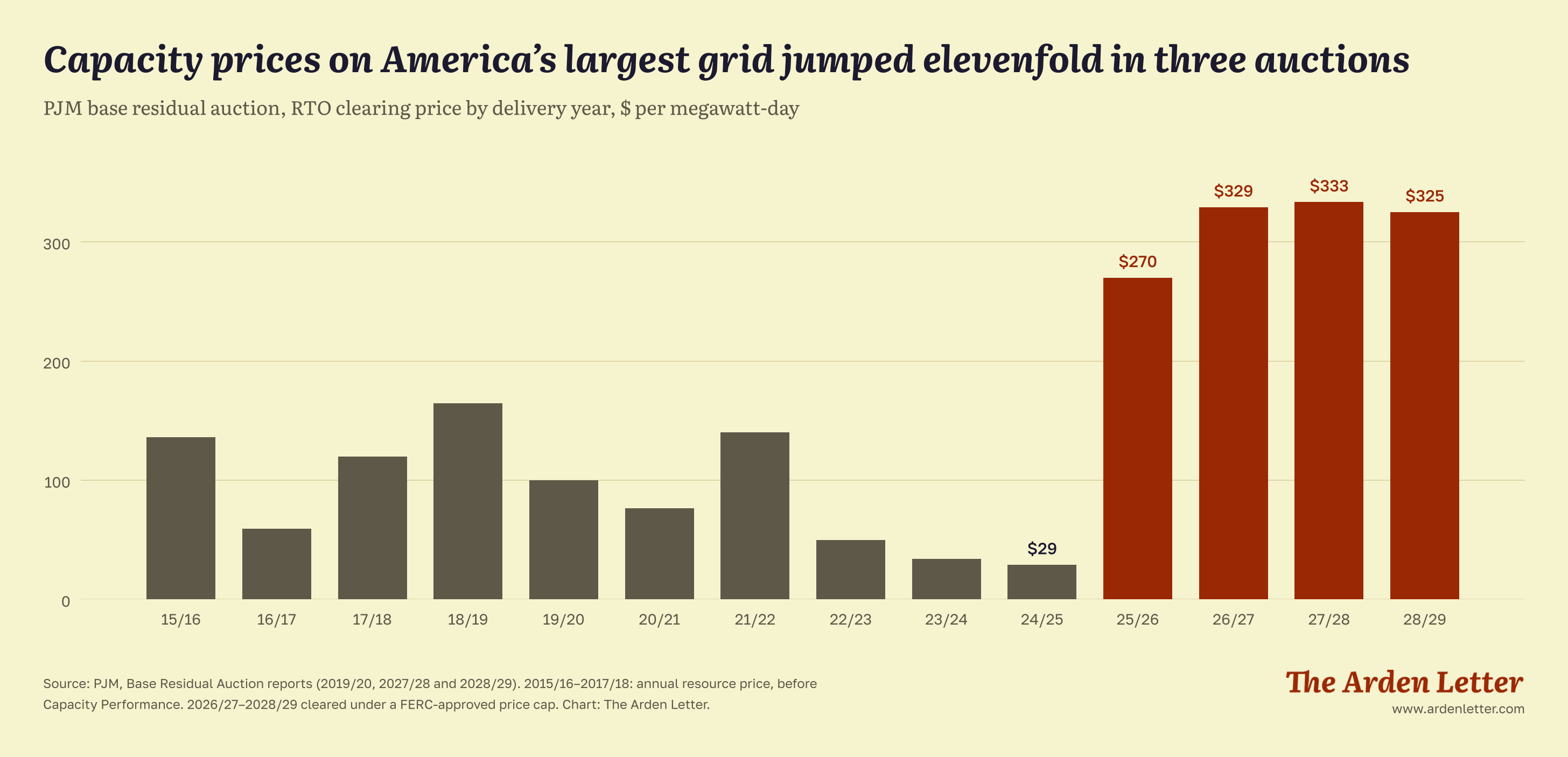
The same logic applies today. The war with Iran has disrupted the Strait of Hormuz since February, and Brent crude went from about $71 to around $130 a barrel. But the shock that will last comes from electricity. In PJM, the grid that serves more than 65 million people from Chicago to Washington, the price of reserving future power capacity jumped from $29 to $333 per megawatt-day in three auctions.
Here’s how I put it last year:
This is why electricity has become the new oil—it can drive broad inflation while the economic structure prevents any compensating wage response.
Unlike oil shocks that affected all sectors relatively equally, electricity inflation will hit unevenly. Data centers and AI companies can absorb higher energy costs given their massive funding (for now). Households and traditional businesses cannot.
Here’s what I’ll cover in the rest of this edition:
How Toyota’s small cars foretold China’s electric car exports
What Nixon’s gold shock and Trump’s tariffs have in common
Why AI data centers look like the supertankers of the 1970s
How the West bought time with Borrowed Decades, and may do it again
What the Nifty Fifty bubble tells us about today’s stock market
Why debt makes 2026 even harder than 1974
How Reagan got allies on board, and why the way out is all about allied scale