



Hi, I’m Nicolas, Head of Research at Vsquared Ventures. Last week, I asked why America constantly runs so hot. Today I want to look at the other end of the same trade and ask the mirror question: why does Germany constantly run so cold?
Picture a highly profitable company. Its engineers are world-class; its products sell everywhere; its margins are the envy of its global industry. Yet year after year, the board refuses to fix the leaking roof at headquarters, keeps raises to a minimum, and wires its spare cash to a rival across the ocean. The rival then uses that cash to fund risky ventures and keeps most of the upside. Meanwhile, in the East, a new competitor is learning to make the exact same products faster and cheaper.
🇩🇪 That company is, of course, Germany. Its engineers and exporters are among the best in the world. It owns net foreign assets worth about 81% of its GDP. Yet its economy is barely larger than it was in 2019. Its rail lines and bridges are crumbling; its households keep their spending to a minimum. As for Germany’s savings, as I explained in The West’s Carry Trade Against Itself, a large part of them crosses the Atlantic, where they help keep America running hot and fund American startups. Meanwhile, China is learning to make the machines Germany used to sell it.
What explains Germany’s cold economy is the exact same machine I described last week. But viewed from Berlin, it runs in reverse: three coupled loops that push savings out of the country—whereas in America, it pulls money in. Here’s how it works: (i) wages keep households from spending (first loop), and (ii) trade turns the unsold output into claims on the rest of the world (second loop). Then (iii) both feed the third loop, which I call the drain—savings that find no use at home simply leave the country. The result is an economy that runs cold; that cold then feeds back on wages and trade—just as China is increasing its competitive pressure.
Yet another fair warning: like last week’s, this edition is a bit wonkish. But it’s an important one, because if America manages the West’s money, Germany is the client paying the fees. And allied scale starts with understanding why. Read along 👇

1️⃣ Germany has saved a fortune, but its economy has stopped growing.
From a macroeconomic perspective, Germany looks just as unusual as America these days, but in the opposite direction. At the end of 2025, Germans owned €3.7 trillion more abroad than foreigners owned in Germany: net foreign assets worth about 81% of GDP. America, by contrast, owes the rest of the world about 71% of its GDP.
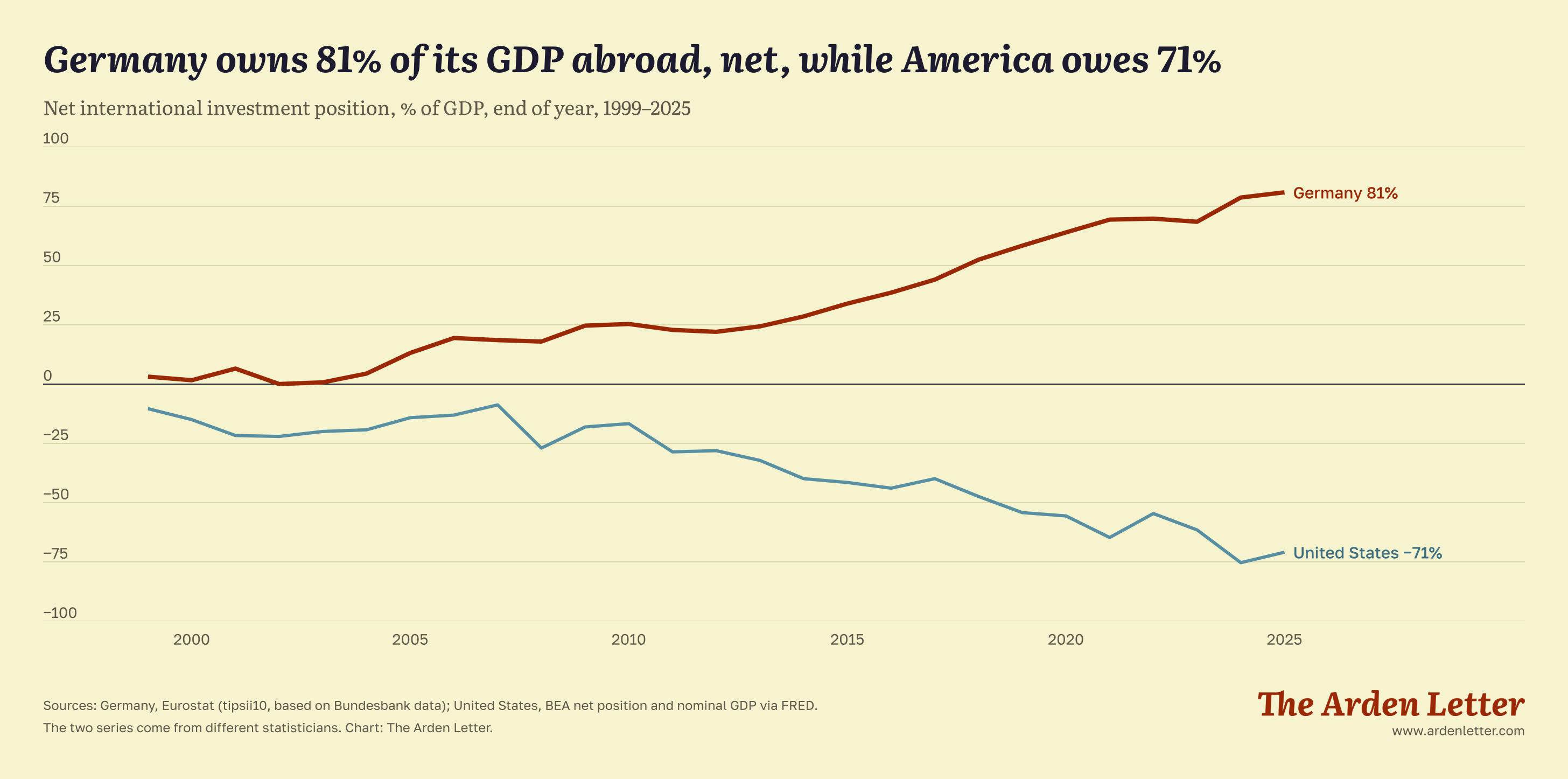
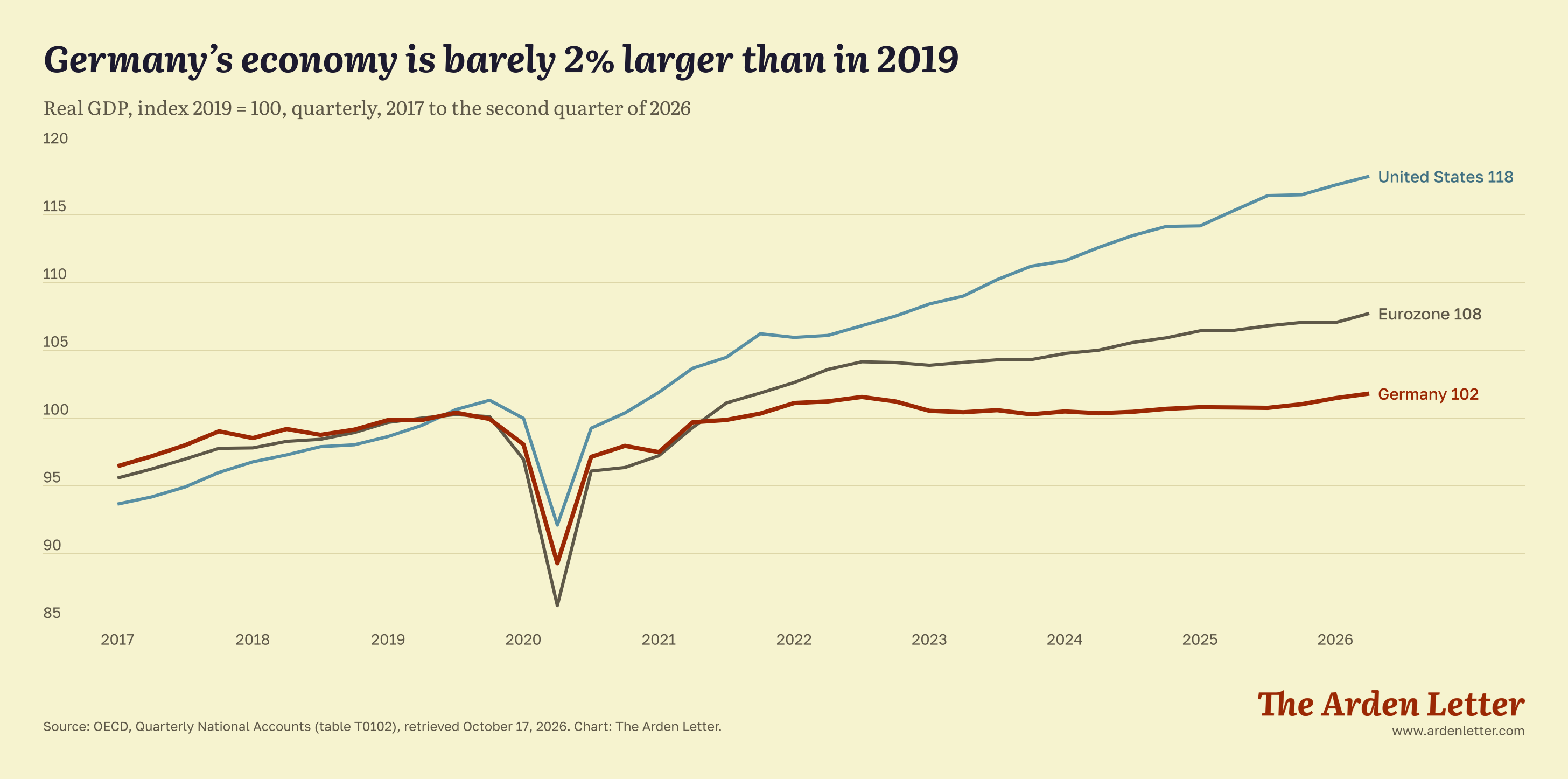
Germany built up these assets by saving more than it invested at home, year after year. A country that saves this much typically looks like a strong economy: after all, it earns more than it spends and lends the difference to the rest of the world. Yet in the second quarter of 2026, German real GDP was only 1.8% above its 2019 average. Over the same period, the euro area grew by 7.7% and the United States by 17.8%.
One thing did change in 2025, though. After decades of fiscal restraint, the Bundestag loosened the infamous constitutional debt brake to fund defense as well as a €500 billion infrastructure fund. In this new context, the government plans to raise €182 billion in 2026. In the first half of the year, the general government deficit reached 3.1% of GDP, and ten-year Bund yields climbed to 3.3%, their highest level in 15 years.
Look at the private side of the economy, though: the cold hasn’t lifted at all. Households still save and refrain from consuming, companies still hold back, and money still leaves the country. So the real question is, where does all that German money go?
2️⃣ Germany earns little on the money it invests abroad.
To understand the math, look at Germany the way I looked at America last week: as a financial institution. From this perspective, if America is the world’s largest alternative asset manager, which I have been calling “America Capital Partners,” then Germany is one of its most loyal (and less demanding) limited partners. Let’s call it Schwarze Null Mutual, after the “black zero” of a balanced budget. It hands over its savings, accepts a modest return, and lets the manager keep the upside.
As a matter of fact, economists Franziska Hünnekes, Moritz Schularick, and Christoph Trebesch found that since 1975, Germany’s yearly returns on its foreign assets averaged about 5 percentage points less than America’s. Had Germany earned what Norway or Canada earned over the same period, it would have been €2 to 3 trillion richer in the decade after 2008 alone. Germany as an LP also pays a yearly fee to America Capital Partners: in 2025 alone, exchange-rate moves, mostly the falling dollar, cut €228 billion from the value of German foreign assets.
The system keeps the money moving through three connected loops. The wage loop is about German households putting aside much of what they earn instead of spending it. The trade loop is about German firms selling abroad what households can’t buy at home. Both pools then pour into the drain, which sends them abroad because nothing at home asks for them. The result is an economy that runs cold, with the cold then feeding back on both wages and trade.
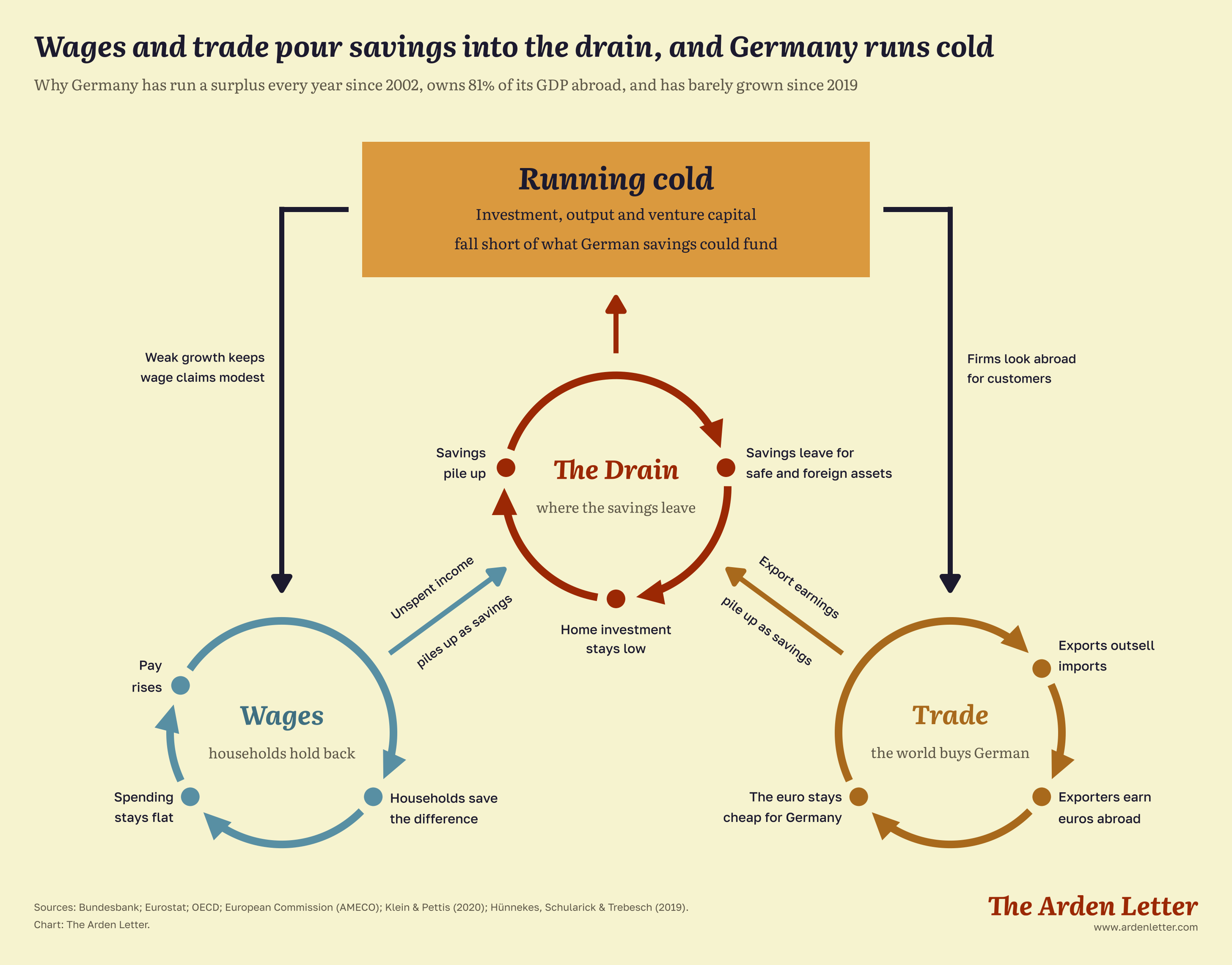
That’s the system described in one chart. The rest of this edition walks through each loop and leads to the question at the heart of this newsletter: if German savings keep America running hot, why not put them to work where Europe’s builders are instead?
Along the way:
Why did German wages fall behind productivity, and why do households keep saving now that it has caught up?
How does the euro let Germany sell abroad what its own citizens can’t afford?
Why do German savers buy American stocks and fund so few German startups?
And if the ECB can’t warm Germany up, who can?